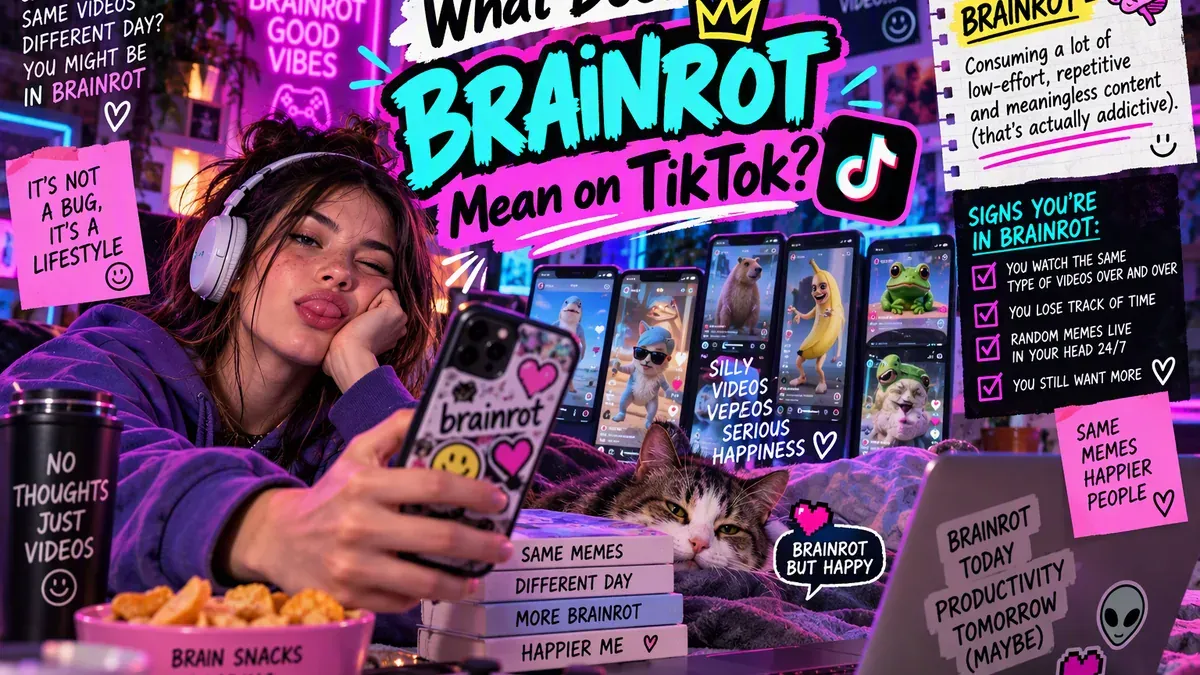
‘Brainrot’ means two things at once: the junk content of the internet, and the state it leaves in your head. When you say “this is brainrot,” you are calling the video absurd and worthless; when you say “this is giving me brainrot,” you mean you have been watching it for two hours and can no longer think straight.
Short answer: brainrot (also written brain rot) is the mental hangover from too much meaningless content. You use it to judge the video and, most of all, to laugh at yourself.
The word was coined to describe one thing and ended up describing three: first the poison, then the symptom, then an entire aesthetic. Oxford named it Word of the Year in 2024, and in 2026 it is still alive while the vocabulary around it gets renewed every season. Here is where it comes from, how to use it well and what travels with it.
Where it comes from
The phrase is not from the internet. It shows up in the nineteenth century: Henry David Thoreau used brain rot in Walden (1854) to complain that people prefer easy thinking to complex thinking. Three centuries later the idea fits so well that we dug it back up without changing a comma.
Online it appears on forums and 2010s Tumblr as a joking self-diagnosis: “I’ve been online all day, it’s giving me brain rot.” The use stayed modest until two things happen in 2023. On one side, Skibidi Toilet becomes the most-watched web series in history and drags a whole generation into humor without a plot. On the other, streamer Kai Cenat’s circle drops a batch of words that spread everywhere: rizz, gyatt, fanum tax, sigma.
In under a year, all those words merge into a single register, and both young and old have a name for the phenomenon: brain rot. Between 2023 and 2024 the word’s use grew 230% according to Oxford, and on December 2, 2024 it was announced as Word of the Year, ahead of demure, slop and romantasy.
The three uses of the word
The confusion comes from brainrot meaning three different things depending on context, and people use all three the same day:
- The state. “I have brainrot” is the mental fog after an hour of scrolling: you can no longer read a long text or follow a full conversation. It is the symptom, not the disease.
- The content. “This is pure brainrot” points at the material: absurd, repetitive videos with no narrative, made to be swiped past rather than watched. A dancing cat, an AI speaking invented Italian, a slideshow of memes.
- The vocabulary. “They speak brainrot” describes the language: a person interleaving internet references into normal sentences, often without knowing exactly what they mean.
The trick is that nobody says it seriously. Calling your own feed brainrot is a funny way to criticize the habit without giving it up. The researcher Mimi Ito calls it a “genre of participation”: some people study on TikTok, some stalk people, some switch their brain off on purpose. Brainrot is the third door.
How to use it well
It works when you admit you are watching garbage and enjoy it anyway. That is the condition. The word is a funny confession, not health advice.
SOUNDS NATURAL:
- “My feed has been brainrot since Thursday”
- “Three hours in, it’s giving me brainrot”
- “This show is premium-grade brainrot”
- “Sorry, I only speak brainrot today”
WHAT KILLS IT:
- Using it to describe another person like a doctor: “you have brainrot” sounds like contempt, not humor.
- Writing it as a real illness in a serious message. Nobody has been diagnosed with anything.
- Explaining the joke. If you have to define the word in the conversation, the moment is already gone.
Real examples
The 3 a.m. scroll. “I closed TikTok at three and opened Instagram. That’s brainrot with a break.” Here the word describes the habit with humor: it is not that you cannot stop, you just changed aisles in the same supermarket.
AI content. The generated characters with invented names (Tralalero Tralala, Ballerina Cappuccina) were the brainrot of 2025: made by a machine, no joke, adored by millions. Calling that kind of video brainrot is almost a taxonomy now.
Someone else’s vocabulary. “My ten-year-old cousin explained Ohio videos to me and now I have brainrot.” Double meaning: you got told garbage and you kept it.
When NOT to use it
- For real attention problems. If you have spent months unable to focus anywhere, that is not brainrot: it is something worth looking at calmly. Keep the word for the light stuff.
- As a direct insult. Telling someone “you have brainrot” stops being a shared joke: it is calling them dumb. The term is for the phenomenon, not for people.
- In formal settings. At work, with a teacher or with people who are not online, the word does not land and just reads as noise.
Similar terms you should know
If brainrot felt too basic, note these, which are the ones circulating right now:
- Aura / aura farming → having status, or chasing it on purpose: “that gave him aura.”
- Crash out → an anger spike or a meltdown: “he crashed out over a comment.”
- Mogging → coming out better than someone in a comparison, especially looks.
- 6-7 → a number with no meaning yelled at random with a hand sign. Brainrot in pure form.
- Nonchalant → acting unbothered, as if nothing affects you. An ordinary word used with new fervor.
And the one you already know: delulu. Delulu is the fantasy you know will not happen; brainrot is the noise that keeps you from noticing. The two live in the same conversation all the time.
Frequently asked questions
Is brainrot an illness? No. It is an internet word for a real sensation: that empty-headed feeling after too much scrolling. There is no clinical diagnosis, and the research on the topic is still unsettled.
How do you spell it? Both forms work. Brain rot is the original English, two words; brainrot is the compact form young people use, and the one you will see most on TikTok and in headlines. In English it is written the same either way.
Who coined the word? There is no single author. Thoreau used it in 1854 in a serious sense, the internet turned it into a self-diagnosis in the 2010s, and the generation that grew up with Skibidi Toilet popularized it in 2023. It is a word with two centuries of history and three years of fame.
Is it only on TikTok? It was invented and spread there, but it now appears in newspaper headlines, in parliamentary speeches and even in video game titles. When a TikTok word reaches a broadsheet, it has stopped being just TikTok’s.
Why does it still sound fresh in 2026? Because it recycles. The words around it (skibidi, gyatt) are fading, but brainrot stayed as the name of the whole category. As long as content exists that is designed only to be swiped, the word for it will exist too.
The problem is not watching it, it is not knowing what it is
Calling brainrot what you watch has something healthy in it: it means you can still tell apart what feeds you and what only occupies you. The real risk starts when you can no longer tell, when the whole feed is the same and the word does not occur to you either.
The answer is not to quit. It is to alternate: something short and absurd, something long that demands effort. The mix is what keeps brainrot from being the only genre of your afternoon.
What is the most brainrot thing you have found on your FYP this week? 👇